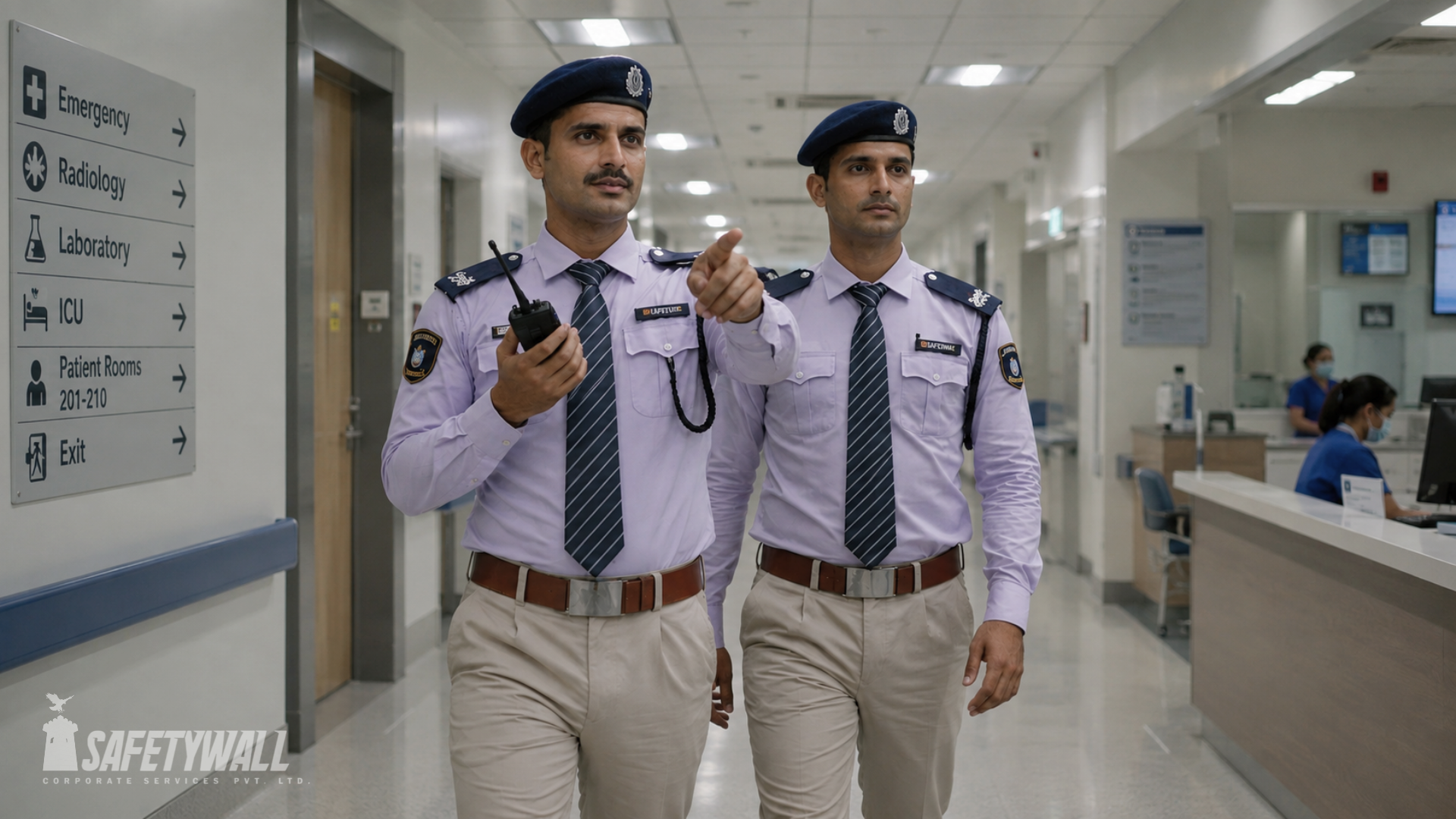
Hospitals are among the highest-risk environments for security lapses. Patients, families, staff, medicines, equipment, and sensitive records all move through the same corridors often 24/7, often under stress. Yet security is frequently treated as an afterthought in facility planning, outsourced to whichever vendor offers the lowest quote.
For healthcare administrators, that approach is a liability waiting to happen. Here's what hospitals should actually be demanding from a security vendor.
1. A Valid PSARA License (Non-Negotiable)
Under the Private Security Agencies (Regulation) Act, 2005, every security agency operating in India must hold a state-issued PSARA license. This isn't paperwork for its own sake it's the baseline that confirms an agency has met government mandated standards for guard training, verification, and conduct.
For hospitals specifically, this matters more than most sectors: an incident involving unlicensed security personnel can complicate legal liability, insurance claims, and regulatory standing on top of the immediate safety failure itself.
Ask for the license number, confirm it matches the contracting entity, and verify it's valid for your state.
2. Documented Background Verification
Security personnel in a hospital have access to vulnerable patients, restricted wards, pharmacy areas, and sensitive information. A generic "we do background checks" isn't enough. Demand documentation showing:
- Police verification for every guard, not a sample
- Address and identity verification
- Employment history checks
- Any past disciplinary or criminal record disclosures
If an agency can't produce this per-guard documentation on request, that's a gap not a technicality.
3. Healthcare-Specific Training
Hospital security is not the same as guarding a warehouse or office lobby. Guards need training in:
- Handling distressed patients and family members
- De-escalation in emotionally charged situations
- Restricted-zone protocols (ICU, maternity, pharmacy, records rooms)
- Coordinating with hospital staff during medical emergencies or code situations
- Visitor management and infant/patient identification protocols
Ask the vendor directly: what does your healthcare-specific training curriculum look like, and how often is it refreshed?
4. Clear Shift Accountability and Uniform Standards
Hospitals run round the clock, and security gaps often appear during shift transitions or night hours. A compliant vendor should provide:
- Documented shift logs and handover protocols
- Consistent uniform and ID badge standards for easy identification
- A clear escalation chain if an incident occurs during any shift
5. Responsiveness and Accountability, Not Just Manpower
Many hospitals judge security vendors purely on headcount and cost per guard. The better question is: when something goes wrong, who is accountable, and how fast do they respond? A vendor that treats guards as interchangeable manpower rather than trained, verified professionals tied to documented standards will struggle to answer that question.
Why This Matters Beyond Compliance
Getting this right isn't just about avoiding regulatory trouble. It's about:
- Patient and staff safety in an environment where trust is everything
- Audit readiness for NABH, JCI, or insurance inspections
- Reputational protection, a single security failure at a hospital makes headlines fast
- Operational continuity, untrained or unverified guards create liability the hospital ultimately absorbs
---
At SafetyWall, we provide PSARA-licensed, background-verified security personnel with training tailored to healthcare environments. If you'd like to review our compliance documentation before making a decision, we're happy to share it.