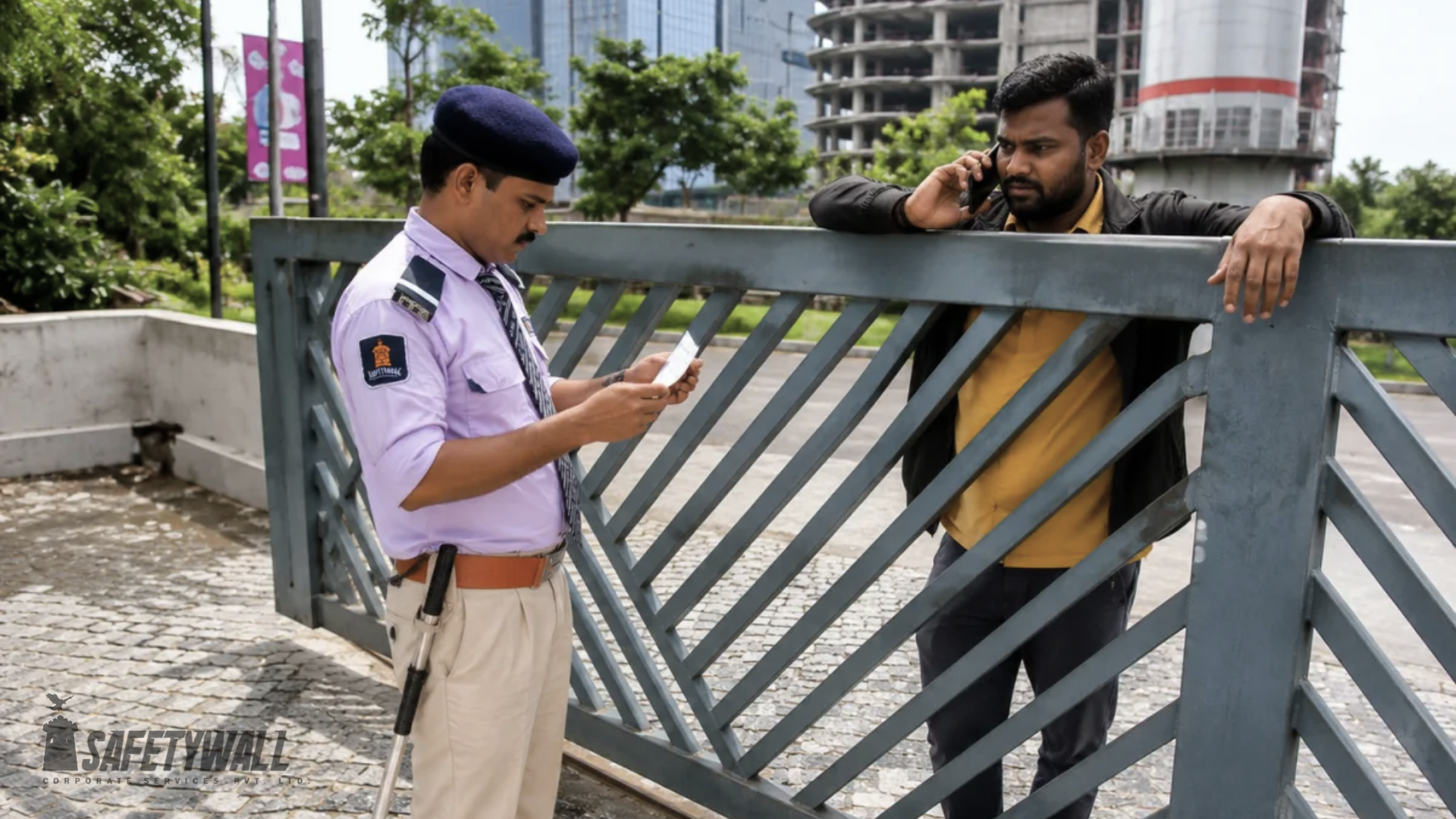
Corporate facility managers are increasingly careful about verifying a security vendor's PSARA license. Residents Welfare Associations (RWAs) managing gated communities and apartment complexes, however, often treat the guard at the gate as a given, rarely asking what sits behind that uniform. That gap in diligence can cost a housing society far more than it realizes.
Yes. RWAs Should Verify PSARA Just Like Any Other Client
The Private Security Agencies (Regulation) Act, 2005 doesn't distinguish between a corporate client and a residential society. Any entity hiring a private security agency to supply guards, whether it's an IT park or a 200 flat apartment complex, is the agency's client, and the same compliance questions apply:
- Does the agency hold a valid, current PSARA license for your state?
- Is the license issued to the entity actually named in your contract?
- Are the guards deployed at your gate the ones covered by that license, or has the work been quietly subcontracted?
A gated community is not exempt from these checks simply because it's residential rather than commercial.
Why RWAs Are Often More Exposed Than They Realize
When an RWA signs a contract with a security agency, it's generally treated as the Principal Employer under labor law, a position that carries more responsibility than most residents expect.
This matters because:
- If the security agency defaults on statutory obligations, EPF or ESIC contributions for its guards, for example, regional labor authorities can hold the RWA liable alongside the agency, precisely because of this Principal Employer relationship.
- If a security incident occurs involving an unlicensed or unverified guard, the RWA, not just the agency, can face scrutiny over whether it exercised reasonable diligence in choosing its vendor.
- Unlike a corporate facility with a dedicated procurement or legal team, RWAs are typically run by resident volunteers, which makes it easier for compliance gaps to go unnoticed until something goes wrong.
In short, the stakes of hiring an unverified security agency are arguably higher for a residential society than for many commercial clients, simply because RWAs have fewer internal safeguards catching the gap.
What Every RWA Should Be Asking Before Signing
- License verification. Request the agency's PSARA license number and confirm it matches the contracting entity's name and is valid for your state.
- Per guard documentation. Ask whether every guard deployed has undergone background verification and training, not just a sample of the agency's workforce.
- Statutory compliance proof. Since the RWA can be held liable as Principal Employer, ask for evidence of EPF and ESIC compliance for the guards assigned to your community.
- Contract protections. Make sure the contract allows immediate termination for cause, such as intoxication on duty, physical altercations, theft, or cancellation of the agency's PSARA license, rather than being locked into a long notice period regardless of circumstances.
- Transition planning. Ask what happens during a vendor changeover. The gap between one agency leaving and another taking over is often a community's most vulnerable window, and a good contract addresses it explicitly.
A Simple Record Keeping Habit for RWAs
Even though the security agency carries the primary compliance burden under PSARA, a diligent RWA benefits from keeping its own light file: a copy of the agency's current license, the contract, and periodic confirmation that the license remains valid and unexpired, since licenses do lapse and require renewal every five years.
The Bottom Line
PSARA compliance isn't just a corporate procurement checkbox. It applies just as directly to the RWA signing a contract for a residential gated community. Given that RWAs are typically run by volunteer committees without dedicated legal or compliance staff, and face real liability exposure as the Principal Employer, a few minutes of verification before signing is one of the simplest ways a housing society can protect both its residents and itself.
At SafetyWall, we work with gated communities and RWAs the same way we work with corporate clients, with current, verifiable PSARA licensing and documented guard verification. Happy to share our compliance documentation before your committee decides.