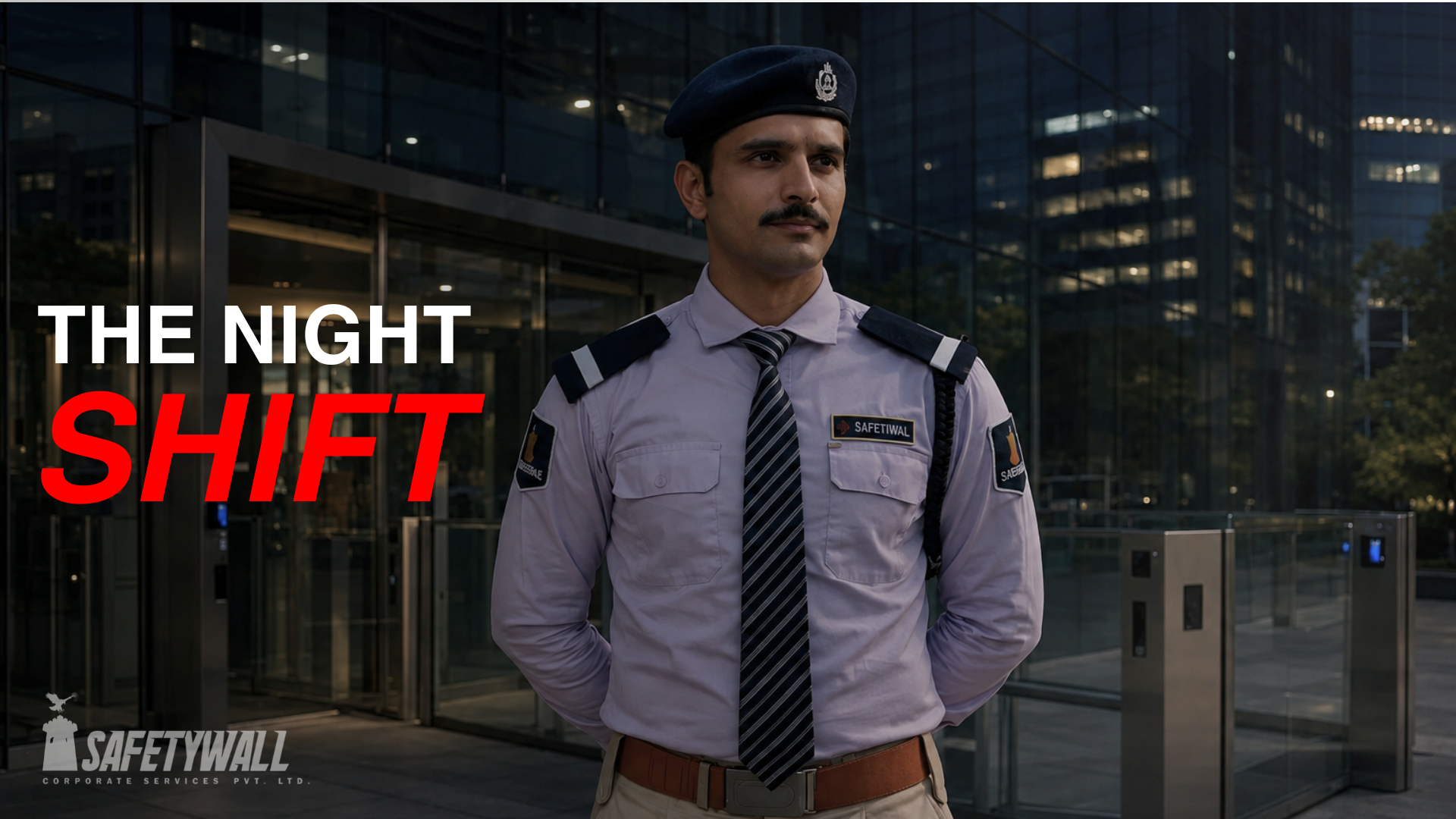
Most facilities design their security plan around daytime operations visitor management, access control at peak hours, monitored entry points. Night shift security often gets treated as a scaled-down version of the same plan: fewer guards, same protocol, minus the crowd. That assumption is where most of the actual risk lives.
Night shift isn't daytime with fewer people. It's a different operating environment, and it needs to be planned as one.
The Coverage Illusion
A facility that runs three guards during the day and one at night looks like it's simply scaling down with demand. But demand for security doesn't drop the way foot traffic does if anything, the risk profile changes. Fewer people on-site means fewer eyes to notice something wrong, fewer witnesses, and a longer window before an incident is even discovered. A single guard covering a large perimeter alone isn't a scaled-down daytime plan it's a fundamentally weaker one.
Fatigue and Alertness Are Rarely Accounted For
Night shifts fight human biology. Alertness naturally dips in the early morning hours, and a guard on a long, low-activity shift is more prone to lapses than one moving through a high-traffic daytime environment. Facilities that don't actively manage this through rotation schedules, patrol checkpoints, or scheduled check-ins are relying on individual willpower to cover a structural gap.
Response Time Gets Overlooked
During the day, an incident gets noticed and escalated quickly because there are more people around to raise the alarm. At night, that chain breaks down. If your escalation plan assumes daytime response times a supervisor readily available, backup staff nearby, management reachable it likely doesn't hold up at 2 a.m. Facilities need a night-specific escalation protocol, not an assumption that the daytime one still applies.
Access Control Gets Looser, Not Tighter
Ironically, many facilities loosen access discipline at night, not tighten it. Fewer staff means fewer people questioning unfamiliar faces, and a lone guard managing a checkpoint has less capacity to properly verify every entry compared to a fully staffed daytime team. Vendors, delivery staff, and after-hours contractors moving through a facility at night often get less scrutiny than the same person would during business hours precisely when scrutiny matters more.
Blind Spots in Physical Coverage
Daytime security plans are often built around where people naturally gather main entrances, lobbies, high-traffic corridors. At night, those same spaces are empty, while parking areas, loading docks, and perimeter zones become the areas actually worth watching. A patrol route designed for daytime foot traffic frequently misses exactly the zones that matter most after hours.
Communication Gaps Between Shifts
The handover between day and night security is one of the most overlooked risk points in facility management. Incidents, flagged visitors, maintenance issues, and open concerns need to transfer cleanly from one shift to the next — but without a structured handover process, that information often just doesn't make it across. A night guard walking into a shift with zero context from the day team is starting from a blind spot that didn't need to exist.
What a Real Night Shift Plan Looks Like
Closing these gaps doesn't necessarily mean doubling headcount it means treating night security as its own operational plan: adequate coverage relative to the facility's actual size and risk profile, structured patrol routes built around night-specific blind spots, a clear and tested escalation protocol, and a documented shift handover so nothing gets lost between day and night teams.
At SafetyWall, night shift security is planned as its own operation not a smaller version of the daytime one.
Want a second opinion on whether your facility's night shift coverage actually holds up? Get in touch with SafetyWall.