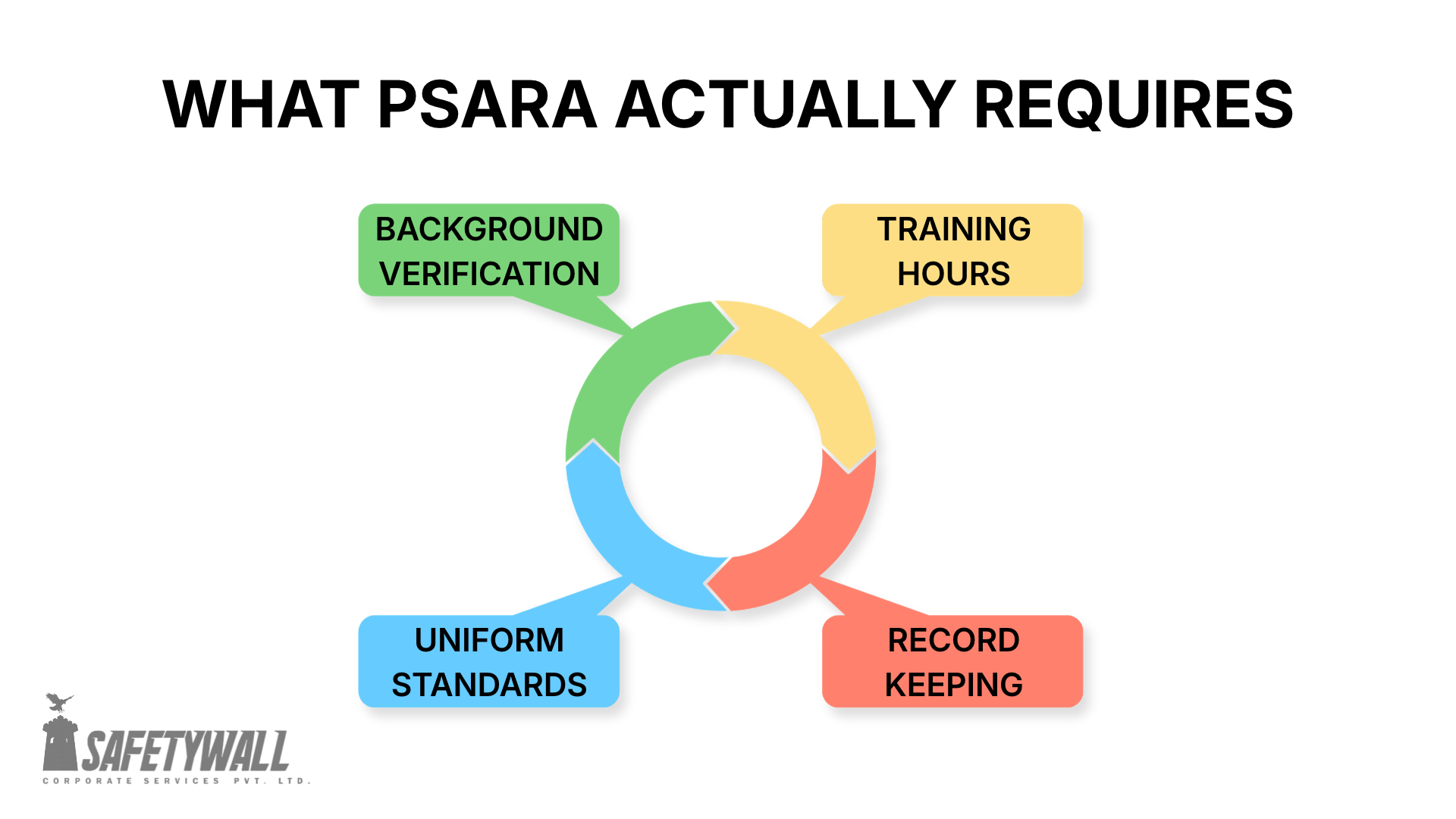
"PSARA licensed" gets thrown around a lot in the security industry often as a one-line credibility claim on a website or pitch deck. But most clients never ask what actually sits behind that license. Here's a plain breakdown of what the Private Security Agencies (Regulation) Act, 2005 actually requires from an agency, and why each piece matters.
1. Background Verification of Every Guard
Before any agency can deploy a security guard or supervisor, PSARA mandates character and antecedent verification for that individual. In practice, this means:
- Verification of identity, address, and employment history
- Character and antecedent checks, often cross referenced against police and criminal record databases
- Documentation that must be maintained and made available for inspection
This isn't a one time formality agencies are required to keep an updated register of personnel that includes photographs, verification status, and training records for every guard on their books, not just a sample.
2. Mandatory Training Through a Recognized Institute
An agency cannot simply hire people off the street and put them in uniform. PSARA requires:
- A Memorandum of Understanding (MOU) with a state recognized security training institute
- Guards and supervisors to complete training as per the syllabus prescribed by the state's Controlling Authority
- Key managerial personnel to hold a Special Training Certificate from a recognized institute
Training hours and curriculum specifics are set by each state's Controlling Authority, so requirements can vary slightly from state to state but the underlying principle is the same everywhere: no guard should be on duty without documented training behind them.
3. Uniform and Identification Standards
PSARA is specific about how a security guard must be visually identifiable and deliberately distinct from police or armed forces. Standard requirements include:
- A defined uniform (shirt, trousers, belt, cap, shoes) that must not resemble police, army, or paramilitary uniforms
- An arm or shoulder badge identifying the agency and the guard's position
- A visible ID card showing the guard's identity number, name, designation, and validity period, signed by both guard and employer
- A whistle and notebook carried during duty for incident logging
These aren't cosmetic details they exist so that anyone on the premises can immediately identify a guard as legitimate, verified personnel.
4. Ongoing Record Keeping, Not Just a One-Time License
Getting the license is the starting point, not the finish line. A compliant agency is expected to maintain:
- A register of all security personnel with verification and training records
- A register of clients and services provided
- Renewal compliance, since PSARA licenses have a validity period and must be renewed on time
Why This Level of Detail Matters for Clients
When a facility manager or business owner hires a security agency, "PSARA licensed" should mean something concrete: every guard on site has been background-checked, trained through a recognized institute, and is identifiable through standardized uniform and ID protocols with records to prove it.
That's the difference between an agency that treats the license as a checkbox, and one that treats it as an operating standard.
At SafetyWall, PSARA compliance isn't just a certificate on file it's built into how we verify, train, and deploy every guard. Happy to walk you through our documentation before you decide.